
|
|
|
|
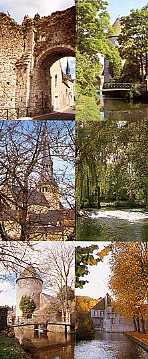
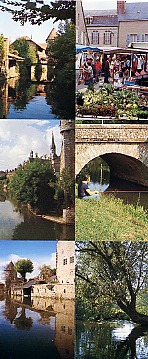
The Cradle of the Family(Le Berceau de la Famille)From research by our (4th) Cousin Maurice, in France, the area around Bonneval is believed to be the "cradle" of the Alberque family. It is 30 km. south of Chartres, and about 1.5 hr. drive from Paris. It is described as Une Vallee Heureuse (a happy valley) between the "Cathedral and the Castles" (Chartres and the Loire Valley). It offers medieval charm (abbeys, forts and ancient homes), dating from the 12th century, in a lush green setting, amid the rivers, Eure and Loir, and canals. The towns where "Uncle" Jules was the parish priest (E.G.'s older brother) are also in this area. Jules was the parish priest at Croisilles from 1884 to 1894, Coudray-au-Perche from 1894-1913, and at Toury from 1913-1944. Ernestine, sister of Jules and EG, went to live with her brother Jules, and sister, Helene, when she returned from the US after her mother died. Ernestine is buried in Coundray-au-Perche. Both Helene and Jules are buried in Toury. The pictures below give some idea of what the area is like. See also La Famille 2001 for more pictures of Bonneval following our visit there in August 2001.
A booklet compiled 40 years ago also gives some glimpses into the history of Bonneval. Here are some excerpts, loosely translated: "The famine of 1694, the bad winter of 1708-09, and the flood of 17 February 1711 signaled sadly the end of the grand regime [of Bonneval]; but the general prosperity that had existed for much of the 18th century went to help the city rise above its disasters. From an economic point of view, the construction of the “grand’route” [ it is likely there was a major thoroughfare created heading southwest out of Paris, toward Chartes, Bonneval and Chateaudun], begun in 1759 and continuing with more or less activity for several years, gave it a strong and appreciable advantage; the “pont de l’Isle”, so remarkable, dates from this time. From the political point of view, another improvement was going to respond to the hopes of the nation in general. Just then, at Bonneval, the Royal Overseer, agent of the State, had a preponderable event. His authority was diminished. [Presumably the onset of the French Revolution.] The first of March 1789, a general assembly of the inhabitants of the area got together and listed their grievances. In the new government of France, Bonneval lost its Royal Overseer and became the county seat of the canton in the Chateaudun district [of the Department of Eure et Loir]. The Revolution was calm there and had no victims. A decree of the National Convention, dated 26 July 1793, authorized a citizen, Clavaux, and his business to open a canal joining the Eure and the Loir rivers. This project stayed dormant like all the others which had preceded it. The grand spirit which in 1792 enticed the French toward its menacing borders, did not find Bonneval indifferent. Numerous volunteers left, of which many did not return. Under the Empire, Napoleon 1st crossed Bonneval 4 times, notably the 30 June 1815, on the chemin de l’exil. [Napoleon must have been taken through Bonneval on his way to exile. That must have been a sight for our ancestors.] The Abbey had been sold in 1793 to Pierre Dutartre who installed a cotton factory there. This manufacturing functioned during the Revolution and the Empire. Under the leadership of Alexandre Dufrayer, it perished and the material was placed for sale in the month of July 1820. It was then replaced by a factory of carpeting and coverings under the trade name of Demenou and Cie. A short-lived business, it lasted only from 1820 to 1825. The 13 May 1827, Dutartre sold it to the Marquis d’Aligre, who on 16 May 1828 exchanged it with the Department for the ancient Abbey de Josaphat, under conditions good for Bonneval: “an establishment useful for humanity”. After 15 years of neglect, the Conseil General, in its session of 1843, decided to set up there an agricultural colony for orphaned children. The Institution opened its doors in April 1845 and did not close them until 1861, to make way for an insane asylum, becoming an actual psychiatric hospital with new construction on the old monk’s orchards and with new and modern services. Note in passing: the inauguration of the railroad from Paris to Vendome in 1865."
|